

TWO OBSERVATION EXERCISES
Rita Sixto
(Excerpt from the publication PISCINA.Investigacion y practica artistica. Maneras y ejercicios
Editiones laSia, Bilbao, Februar 2019, ISBN: 978-84-09-08084-7)
I am moved to write by the fascination I feel for
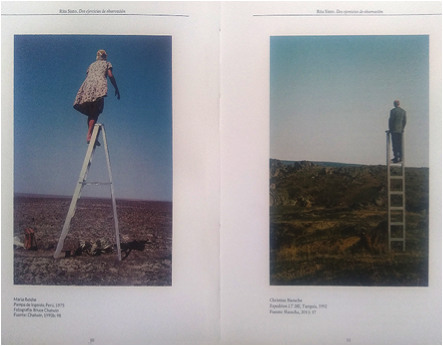
two photographs. By what they have in common: the representation of a figure up
on a ladder, scanning the horizon, facing away from the viewer. But also by the
desire to find out where they part ways, how they differ, and how deep that
difference goes. As I am in search of something elemental, I write with the
naïve intention of starting from the beginning; perhaps any research project,
regardless of the field in which it is carried out, always begins – as this one
does – with an observation exercise. Along the way, I would like to discover
clues to addressing art practice as research.
In any case, I allow myself to be carried along by
the pleasure of talking about the two images; about each in its particularity.
As though I were pulling on the end of a piece of yarn to untangle each;
wanting to record each singular unfolding. With one end in each hand – one
image on the left and one on the right – I unwind them side by side; like
simultaneous rivers flowing in tandem. I allow them to look at each other
across the gap, without interacting or straying from their course. Without
mingling: one advancing always on the side of the evens, the other always on
the odds. And although I know that the power lies precisely in the relationship
that springs up between them, I allow each to find its own path, its measure,
its end. I accept that the conversation this may give rise to will have to take
place after these words are written. THE LADDER, PLACE OF THE SUBJECT
That man is Christian Hasucha (born Berlin-Neukölln
1955), photographed in 1992 by Sabine Philbert-Hasucha in Turkey, somewhere
between Kirklareli and Dereköy. I have thought about this image since 2005,
when I bought a book1 in which
it was printed in black and white, accompanied by a small paragraph summarising
the already brief information that I found – perhaps years later, I can't
remember when – on the artist's website. Then I discovered that Hasucha is an
artist who usually carries out his work in public spaces.
In the early nineties, aware of the dispersal of
his work, Hasucha began to compile the various documents generated around each
action. When this concise graphic and text documentation had been selected and
arranged into projects, it started to become a kind of a catalogue. In May
1991, with funding from a grant, Hasucha embarked on a one-year journey through
various countries in Europe and Asia Minor. He turned his van into a mobile
studio, equipped to make him virtually self-sufficient and allow him to work
anywhere. The actions he carried out on this trip became part of the catalogue,
which gradually grew like an archive: a constantly expanding work in progress
that gave rise to a website2, a key medium of his work. This website contains brief accounts of
Hasucha's interventions during the expedition, in a file labelled Project
no15: EXPEDITION LT 28E 3. The trip came to an end in June 1992. All the interventions had been
carried out in situ, sometimes with the help of locals. All the pieces
were left in place, at the mercy of the community. Hasucha (2013: 60) claims he
cannot say whether some pieces were seen by anybody at all before
disintegrating.
The documentation Hasucha provides as a
record of his activities is clear, well organised, and consistent. Project number,
title, descriptive drawings and technical specifications, photographs, short
texts, dates and location. Everything seems designed to comprehensively account
for each intervention. But even though the material is displayed with the logic
of evidence, it often feels as though we are missing the most important part.
Andrea Knobloch (2013: 67) wonders whether perhaps something is deliberately
kept hidden in order to create a sense of mystery or inaccessibility. And it is
true that when looking at Hasucha's work, in print or on the web, there is a
sense of insurmountable distance. In spite of the documentation made available
to us, the distance appears to grow in line with our interest in the
interventions. Maybe this is why the image has accompanied me, clinging like a
leech (or pinned like a medal).
Hasucha's interventions have taken place outside of
the usual art exhibition rituals. To counteract what he calls the "Disneyland-isation"
of art, Hasucha (2013: 43) has kept his work as far away as possible from
institutional spaces, while also trying to avoid turning his interventions into
tourist attractions. He prepares them in such a way that they are usually only
seen by accidental spectators. For Hasucha, art audiences – amateurs and
professionals – would be "a foreign body" in the place of the interventions,
which are intended for passers-by and local residents. Sealed off from the art
world, Knobloch says (2013: 67), Hasucha's work becomes a kind of "sanctuary".
On the other hand, Hasucha takes into account an
interesting figure that he calls the FP (Fictional Participant). This
character serves as "quality control" (Hasucha, 2013: 71), allowing Hasucha to
imagine the FP's response to his interventions. Hasucha imagines the FP as
somebody who takes an interest in the strange thing he sees, perhaps comes
across some information on it later, and ends up storing it all in his head as
a curiosity. As Knobloch (2013: 67) writes, we must be content to feel like an
FP. That is the only way of gaining entry to the "cosmos" of the "public
intervention". The only way of partaking of the "secret pleasures hidden in the
shady corners," beneath the apparently organised, consistent, coherent surface
of documentation systems.
According to Hasucha (2013: 43) EXPEDICTION LT
28E is an example of what he calls anonymous interventions 4. These interventions are carried out unannounced,
and do not generate any kind of technical documentation. Hasucha provides
little information about the intervention on the Turkish plateau: only the
photograph and two short texts that are displayed when the cursor hovers over
the image. First, basic details (the materials – flattened out wood, painted
and infused into a base – and the place) and then, when the image is enlarged
(by clicking on it), a brief account of the action:
The hill was flat and sandy, the pit for the
base almost excavated and the ladder could be infused. On the next afternoon, I
ventured out on thefirst ascent. Far in the distance, sheep bleated. Turkey,
19925.
The text is short and evocative: a very brief
description of the place and a series of impressions – the ease of excavation,
the patience for infusion, the boldness of the climb, and the listening from up
high. An encounter with the soundscape, with the sounds that come from outside
our field of vision, from beyond the frame, concluding the small text as though
also giving it meaning. Even though there is no reference to the visual
experience, the photograph plays an important role. Relative to the text, the
image could be said to correspond to the end of the event: it could have been
taken after the bleating of the sheep. Although it could also have been taken
while waiting. In any case, once the sheep were heard – only then – Hasucha
could begin the descent.
Hasucha has worked on questions of vision in many
of his projects. Some of the interventions in EXPEDITION LT 28E, for
example, consisted of visually isolating certain elements in the surrounding
area. In Vourenkylä (Finland), Hasucha found a large boulder in the middle of a
gravel and made a wooden panel from which he cut out the shape of the big rock.
When viewed from a particular vantage point, the boulder appeared in isolation,
as a self-representation on the panel. Similarly, at Bozdogan beach in Turkey,
where an island can be seen from the shore, Hasucha cut out the shape of the
island on a sheet of iron and positioned it so that, from a certain position,
the two matched. Passers-by were invited to look, to enjoy the visual trick,
which drew attention to familiar elements that are often overlooked in everyday
life, highlighting them. Hasucha took this control of vision even further in
later interventions, building devices that, like Durer's grid, force the eye –
just one eye – to take a particular position, so that vision is blocked6. In another intervention, working in a
former military training camp, Hasucha somewhat symbolically explored the
relationship between sight and shooting. Aim, focus the eye, shoot: a kind of
interplay between projectile and visual projection7. In the course of his already long career, Hasucha has made observation
devices of different kinds, but each of them is a place for the subject who
looks. We could divide them into groups, starting with what we could call
exercises in controlled vision, such as the examples described above. In this
group, the object singled out by the device – which ensures it is seen – is
less important than the actual seeing exercise. Even the position of the eye is
specified, because the devices are created by reducing the subject to a
geometric point, which must be positioned precisely where perspective starts.
The space is then organised from that spot: a privileged place where distances
and relationships play out in a precise order at a particular moment, when
vision tends to stasis. And when it is intensified, the focus on the point is
so strong, that peripheral vision appears to be forgotten8. These cut-out panels that visually isolate
particular elements function as a kind of trap, as Lacan said all paintings do,
as "contraptions which catch their eye" (Lacan, 2010: 96). So we are dealing
with devices for controlling vision, or with vision that controls, determining
a certain order from the apex of the visual cone that has its origin in the eye:
in the eye of a "Cartesian subject, which is itself a sort of geometrical
point, a point of perspective" (Ibid., 93)
But not all of Hasucha's vision-related interventions
share these characteristics. There is a second group of installations that are also
meant for looking. In Cologne, for example, Hasucha attached a simple metal
platform to a street light pole to create a kind of balcony, where one visitor
per night could listen to the noises of the city, five metres above the ground9. In Berlin, he installed a glass cabin in a
pub, accessible from the street, in which one person could sit and watch – and
be watched10. On one
occasion, he took a white cubicle, which looked as if it had been sliced off an
apartment building, and moved it, complete with furniture and inhabitants, to
scaffolding in a public square. Another time, he placed a similar structure on
the roof of a parking lot11. The
examples in the first group forced the eye to take up a specific position, but
those in the second group, while also being places for observation, tended to
incline the subject towards a different kind of looking, and of listening. In
other words, a different kind of perceptual behaviour. Small balconies,
platforms, windows, and terraces are lookouts placed in such a way that when
the subject is in position, the gaze roams. They are places where there is no
predetermined object to look at, or even a direction to look in. Places that,
perhaps, engender "reception in distraction", to put it in the terms used by
Benjamin (2002: 120); Places in which "the public is an examiner, but an
absent-minded one." The subject is drawn to everything that appears on his
field of perception. His attention is attracted by each element, each distance.
And this is when depth of field comes into play, the sidelong glance,
peripheral vision: distance, but also details, changes… We have moved from the
eye to the body: sensing, thinking, imaginative, shiftable, variable,
articulated, mobile, alive, temporal. Sensitive to smells and sounds, to temperature
and humidity, to curiosity, tiredness, and hunger. Vision does not dominate, it
is dominated by the scene that unfolds before the subject, surrounds him. The
term vision starts to expand, and ends up embracing all other forms of
perception.
Earlier we spoke of contraptions that subjugate the
body and make the eye connect to a specific point: devices that concentrate and
arrest vision (even though time continues to pass), that "tame the gaze", as
Lacan (2010: 116) would say. To fix the position of the subject's eye is to
"lay down his gaze as one lays down one's weapons" (Ibid., 108). It entails
renunciation, withdrawal. The two types of interventions discussed here relate
to the dialectic of the eye and the gaze, as summed up by Lacan, (reading
Merleau-Ponty), based on a distinction between the function of the eye and that
of the gaze: "I see from one point only, but in my existence I'm gazed at from
everywhere." (Ibid., 80) This is the basis of the dialectics of seeing, of the
relationship between the seer's eye and the visible realm: we are seen by that
which we look at. Lacan (Ibid., 81) summed it up as "The split between the eye
and the gaze, between the scopic field and the drive manifested at the level of
the scopic field." And it is interesting to note that at this scopic level, we
are at the level of desire, not demand (Ibid., 111).
As the representation of an observer, the
photograph of Hasucha – the image that compels me to write all of this – is
unsettling, to say the least. The ladder is a contraption for the body, rather
than the eye. The body puts itself at risk in order to see. Hasucha would not
be content to be able to see "what is there". The effort would not be worth it.
It is difficult for the body to feel safe there, just as it is difficult for
his eyes to dominate the territory, to capture it, to subjugate it in some way.
Something is bound to escape: he will move his eyes, his head, his body, as far
as he can. But he will never take possession of the entireterritory in its seemingly
infinite possibility. What he sees will be unstable: particular paths,
temporary, provisional impressions. It will mostly lack the geometric
projection that organises the world according to the laws of perspective. Depth
of field – which is ambiguous and is not under control – will come into play.
It is the gaze "that seizes hold of me," writes Lacan (Ibid., 103), "and that
makes out of the landscape something quite other than a perspective."
But Hasucha is homo faber (Arendt 2005:
315). He travels with a portable studio so that he can make whatever is
required. In this case, a ladder. And the ladder, infused in concrete,
establishes a site, fixes the subject's position, elevates him. While at the
same time it anchors him, separates him from the ground. Sloterdijk took up the
Greek term epoché, which etymologically means "suspension" and in
phenomenology refers to "the gesture of distancing oneself from life"
(Sloterdijk 2013: 36). The ladder creates that distance by which the subject
can remain in suspension, detached, parenthesising his prior knowledge and
reality itself. Sloterdijk (2013: 38) writes that the term epoché brought
the temporality of thinking into philosophical reflection, with both of these –
sensitivity to time and reflexivity – being two of the main features of
cognitive modernity. The ladder could be an in-between place. Not a tool for
seeing better or further, but rather a place of transit and ascent: withdrawing
from the ground and from ordinary perception (Hasucha's eyes may even be
closed). Transcending, becoming, adopting a position of tension, in a situation
akin to ecstasy (Ibid., 50). Like Socrates who would "sink" into thought and
enter a kind of trance that cut him off from his surroundings. An absence, a
"thinking episode" (Ibid., 45), a speechless wonder, "in a state of almost
total immobility" (Arendt 2005: 322). This is the contemplative state par
excellence, essentially silent: a speechless wonder that is traditionally the
beginning and end of philosophy.
But the concrete is new, the body awkwardly
balanced. At last, the sheep bleat. We have the image. Hasucha can climb down
and return to his "life of practice", a mixed state that is "contemplative
without relinquishing characteristics of activity and active without losing the
contemplative perspective" (Sloterdijk, 2013: 17). In the short text that
accompanies the image, Hasucha recounts his active experience. He allows the
contemplative experience to flow from the image. This is the account I find
most moving. Perched atop the ladder, Hasucha must have imagined the FP
(Fictional Participant) and subjected himself to his gaze, and to the gaze
of the photographer, and to our gaze too of course. He must have imagined us.
He must have been seen. By others, and he must have seen himself too. This
brings us back to Lacan saying that just as in the Cartesian cogito the
subject apprehends himself as thought and ends up reduced to a power of
annihilation (Lacan, 2010: 88), there is a "form of vision that is satisfied
with itself in imagining itself as consciousness" (Ibid., 82). For Lacan
(Ibid., 87), the statement I see myself seeing myself is "one of the
essentialcorrelates of consciousness in its relation to representation." This
illusion that allows consciousness to turn back on itself – to see itself
seeing –, he says, is a sleight of hand, because an avoidance of the
function of the gaze is at work in the satisfaction that the subject finds in
contemplation. (Ibid., 82) The gaze, he says, is the underside of
consciousness. (Ibid., 91). The sheep wake Hasucha from his speechless wonder.
While the scopic drive is, Freud said, based on the fact that "the subject sees
himself", listening – the sound that reaches Hasucha: the bleating, perhaps
even the sound of the camera shutter behind him – interrupts that arrow leading
back to the subject, and turns toward the other (Ibid., 202). The contemplative
rapture ends. And the image arrives. The photographic act it brings us confirms
the dialectic of the gaze: what we see and what looks at us in what we see.
Here the gaze is outside: Hasucha is looked at, he is picture: literally
"photo-graphed" (Ibid., 113). The subject and the ladder transpire on one side
of the image, they are lateralised. The centre is empty. If we allow ourselves
to be drawn to it, Hasucha is in our peripheral vision: the vision of the body,
of that which is not dominated. And that central void, perceived as absence,
enters into a relationship with desire (Ibid., 115).
In the image, Hasucha allows himself to-be-seen; he
yields to our gaze. He places us further back, behind him. As though as well as
seeing him we could also share his vision and enter into his strange
contemplative state. Although he will always be ahead, over the horizon, very
still, touching the sky. Never in the centre of our field of vision12.
Perhaps,
as Silvestre (2013: 221) concludes in reference to a landscape by Brueghel13, this type of gaze is less
"detached" than tradition would have it. Perhaps it is instead a satisfied
instinct, a desire, a meeting between inside and outside, in which the
territory is by no means understood as a mere object of observation. Subject
and territory cannot be analysed separately. Hasucha does not just see the
landscape or himself. He sees himself landscape. And at the same time, "The
landscapes sees", said Deleuze and Guattari (1996: 169). They were not
referring to the perception of the landscape, but to the landscape as percept.
As when characters in a novel enter the landscape and "are themselves part of
the compound of sensations" (Ibid.). "We are not in the world," they say, "we
become the world; we become by contemplating it. Everything is vision,
becoming. We become universes" (Ibid.). I think that is how Hasucha entered
that place between Kirklareli and Dereköy. How he became landscape. And to do
so, he had to get there, build a ladder, wait until the concrete base set,
climbit, and remain up there. I do not think it is an exaggeration to say that
perhaps the ladder helped him become "monument", as Deleuze and Guattari (1996:
175) defined it: not as an act of memory, but one of imagination: as a "block
of sensations" that remain so because they vibrate. It is this vibration that
continues to affect me in my status as Fictitious Participant, and leads me to
find a question addressing me every time I look at the image.
1 Shulz-Dornburg (2002): Arte y Arquitectura: nuevas afinidades,
Barcelona, Gustavo Gili. The intervention discussed here can be found on page
102, in the chapter "Observación".
2 http://hasucha.de
3 EXPEDITION LT
28E (http://www.hasucha.de/en/intervention_15/dokumentation.html)
4 Hasucha (2013: 43)
also defined a further two kinds of interventions: guided interventions (created
with participants who were contacted by mail in advance and asked to be
witnesses or users of the modifications produced in their area) and commissioned
interventions (in which the presence of sponsors and/or workers is
necessary).
5 http://www.hasucha.de/en/intervention_15/dokumentation.htm
6 27. Ms. K visits Kirchheim unter Teck (1997). The idea was to
recover the specific vision of someone who had previously passed through the
space, and to highlight the objects that had attracted her attention. For each
of these objects, Hasucha placed small viewlocks in front of panels with
cut-out shapes. Spectators bringing their eye up to the viewlock could see the
chosen object. (http://www. hasucha.de/en/intervention_27/dokumentation.html)
7 61. The
Münsingen Hole (2013). In this intervention Hasucha pushed a long cone pice
through the crown of a maple tree, precisely aligned with a chair that was
placed, ready for visitors. From that position, only the cross-section of the
pipe could be seen, and visitors felt as if they were sitting in front of a
huge target in a cleared section of the crown of the tree. Fittingly, the
documentation for
the action includes a photo of the
projectiles kept on the premises. But in spite of the comparison, visitors
probably relaxed, watching the movement of the clouds or perhaps the path of a
bird. (http://www.hasucha.de/en/intervention_61/dokumentation.html)
8 So-called "tunnel vision" is the most extreme case of loss of
peripheral vision.
9 14. Over the Town (1991).
(http://www.hasucha.de/en/intervention_14/dokumentation.html)
10 38 .The Cabin (2001).
(http://www.hasucha.de/en/intervention_38/dokumentation.html)
11 47.
Trial-Living in Slubfurt (2010). (http://www.hasucha.de/en/intervention_47/dokumentation.html)
12 This decentring is more pronounced in the image included in the web
page, which is in square format, emphasising the power of the centre.
13 Pieter Brueghel
the Elder: River Landscape with an Artist Sketching (1553). Silvestre
(2013: 208).
BIBLIOGRAPHY
Agamben, G. (1995): "Sauf les hommes et les chiens"
in Libération, 7 novembre.
Arendt, Hannah (2005): La condición humana,
Madrid, Paidós.
Benjamin, W. (2002): Selected Writings.
Volume 3, 1935-1938, Cambridge, MA, The Belknapp Press of Harvard University
Press.
Deleuze, G. and Guattari, F. (1996): What is
Philosophy?, New York, Columbia University Press.
Didi-Huberman, G. (1997): Lo que vemos, lo que
nos mira, Buenos Aires, Manantial.
Hasucha, C. (2013): Christian Hasucha.
Öffentliche Interventionen, Nürnberg: Verla für moderne Kunst.
Knobloch, A. (2013): "Waiting for JETZT (NOW)", in
Hasucha (2013) Christian Hasucha. Öffentliche Interventionen, Nürnberg:
Verla für moderne Kunst, pp. 67-71.
Lacan, J., (2010): El seminario de Jacques
Lacan: libro 11: los cuatro conceptos fundamentales del psicoanálisis,
Buenos Aires: Paidós.
Silvestre, F. L. (2013): Los pájaros y el
fantasma: una historia del artista en el paisaje, Salamanca, Ediciones
Universidad de Salamanca.
Sloterdijk,
Peter: (2013): Muerte aparente en el pensar. Sobre la filosofía y la ciencia
como ejercicio, Madrid, Siruela.
THE LADDER, PLACE OF
THE SUBJECT
I came across this
photo owing to its use as the official image at the 2016 Venice Biennale of
Architecture. It jumped from the screen, pouncing on me as though I had been
waiting for it. The curatorial team, led by architect Alejandro Aravena,
explained that the image captured "the spirit, the atmosphere, and the scope of
the Biennale" (Quintal, 2016) "As soon as we saw the photo of Maria Reiche, we
all agreed to use it without hesitation. It's the kind of image that requires
no explanation" (Planas, 2016). The Biennale aimed to offer new perspectives,
new angles from which to meet the challenges that architecture has to face.
According to Aravena, Maria Reiche had found that new point of view: standing
on the ground, the stones were just random gravel, but with a humble aluminium
ladder as a tool, she found the place from which "those stones became a jaguar,
a tree or a flower" (Aravena, 2016). That was the image: a person making the
best of the things around her to attain a different perspective, unavailable
to those who remain standing on the ground. Aravena added that "it is a very
important lesson about capacity and creativity being applied not only to the
project or the solution, but even to the tools, to the understanding of the
procedures that are required to deliver quality of life" (Quintal, 2016).
The photograph was taken by Bruce Chatwin; traveller,
photographer, and writer. Chatwin came across Maria Reiche at Pampa de Ingenio,
a desert plain at the foot of the Andes. In an article published in The
Sunday Times in 1975, Chatwin described her as "a tall, almost skeletal,
German mathematician and geographer who has spent about half her seventy-two
years in the Peruvian desert" (Chatwin, 1990: 94). Maria Reiche (Dresden 1903 –
Lima 1998) had arrived in Cusco in 1932 to work as governess for the children of
the German consul, and later worked in Lima as a teacher, restorer of
pre-Colombian textiles, and translator. It was in this role that she met
archaeologists including Dr Paul Kosok, a historian of ancient Peru who had
observed astronomical correlations in the desert markings and took Reiche to
Nazca as his assistant. When he returned to the United States, Kosok encouraged
her to continue the work and apply her knowledge to the study of the glyphs.
She took up the suggestion with such enthusiasm that she devoted her life to
it. In 1945 she moved to the desert, where she lived in a small abandoned hut
without electricity or running water. All alone and with very limited means,
Reiche decided to use her background as a maths teacher "to study the drawings from
the mathematical point of view," because, she wrote, "the remarkable precision
with which they were executed particularly calls for study." Although
sheacknowledged that it was a subject for archaeologists, she believed that the
Nazca drawings "should rather be treated as a chapter in the history of
sciences. Considered as such, they are fascinating" (Reiche, 1968: 12). In
continuing Kosok's work, she never neglected to look for correspondences with
the movement of the stars, or possible connections between the figures and the
constellations. And although she also considered that the lines and figures may
have been ceremonial in nature, she never ceased to believe that she was in the
presence of a vast astronomical calendar1.
The Nazca Lines are
shallow trenches dug into the surface of the desert more than two thousand
years ago: long lines, trapezes, triangles, zigzagging and oscillating lines,
spirals, and various figures. The superficial layer of the ground they were
scraped from is made up of sand and pebbles that are darker than the subsoil
below. Although this first layer is easily disturbed, the climate and the
properties of the land have favoured the preservation of the drawings. The long
lines had been thought to be old roads, or the remains of irrigation systems.
Although they were discovered in 19272, they were unremarked by scholars and
the general public until Kosok and Reiche took an interest in them. According
to Reiche's account, Kosok detected the presence of figures when, much to his surprise,
he saw "the shape of a bird emerge on his drawing board as he plotted the
measured sections of a strange path (Ibid., 72). On the ground, the
archaeologist had not been able to recognise the figure. It was only with the
change in scale, when it was transferred to paper, that the animal appeared.
To a walker, each line is merely a path. A walker does not notice that
the track is an outline, that a single, unbroken, curved path forms a figure.
After years of experience, Reiche wrote that when "walking across the pampa you
come across a section of curving path, you know there is a figure" (Ibid., 34).
It makes sense that Maria Reiche should want to put distance between herself
and the ground, to ascend. Naturally, she started by studying all the aerial photographs
she could find. She was also granted requests for special flights over the
drawings, and she herself took photographs from helicopters and light aircraft.
It is said that she even had herself strapped to the skids of a helicopter so
she could take photographs without the cabin getting in the way. But by the
time she spoke to Chatwin (1993: 111), she had come to consider the aerial
photos imprecise. They did not answer her questions. She needed contact with
the ground. On foot, of course, without road vehicles that could easily damage
the lines. Simply to walk, equipped with a compass, sextant, some string,
measuring tape, something to eat, a broom for sweeping the lines, and the
ladder. Apparently the first ladder she used belonged to the electricity
company. The aluminium one in the photo must have been much lighter.
Walter Benjamin
writes about the difference between walking along a country road and flying
over it by airplane: "Only he who walks the road on foot learns of the power it
commands" (Benjamin, 2016: 27). Benjamin likens this to the power of a text
when it is read, which is different from the power it has when it is copied
out. Just as the road commands the walker, the text commands the person who
copies it: "The mere reader never discovers the new aspects of his inner self
that are opened by the text" (Ibid., 27). To read is to fly over. Maria Reiche
did not just want to fly over, she was not content to read. She need to copy
out. Much of her work consisted of transferring the desert lines onto large
pieces of paper. The lines that were illegible to readers who remained on the
ground. At each elevation – ground, ladder, helicopter – the grooves revealed a
particular type of information. All levels were necessary, complementary. Determining
the distance from which to observe became key to the research process.
When she published Mystery
on the desert (1968), Reiche thought that it was not yet time for the
drawings to be studied as primitive art. She believed that scholars should
leave aside matters relating to totemism, religion, magic, and rituals, and
instead "devote ourselves to studying the means and methods used by the authors
of the huge drawings" (Reiche, 1968: 91). One of her immediate concerns at the
time was to figure out the standard unit of measurement used to enlarge those
complicated shapes. She thought priority should be given to the study of how
the outlines had been created, the means used, the procedures followed. "We
need to investigate every detail of this mysterious writing, and, in the manner
of graphologists, obtain information about the character and abilities of the
writer" (Ibid.) Reiche often had to use her broom to sweep away the small
pebbles blown onto the lines by the wind, making them easier to see.
From the ground, she studied the signs of repetition,
corrections, and replacements that had been made by the creators of the lines.
She recognised the stones used to mark the centres of the circular segments
that make up the big curves. She continued in this way, eventually
discovering, for example, how the giant spirals had been plotted, specifying
the length of the string with a peg at either end and the position of the pegs,
stuck in the ground in a triangle, and stretched out to scratch the surface.
Chatwin (1990: 100) recounts how she spent a morning showing him how the
outline of the spider had been made: a "succession of smoothly joined arcs of
very different radii." With aerial photographs "I would never get the centre of
radii," she told him. For Reiche it no longer sufficed to know that the lines
created the shape of a spider, she needed to know more. What she wanted then
was "to follow in the footsteps of those ancient topographers and discover
their methods" (Reiche, 1968: 45). To understand how the drawings had been
made, to recreate them on the large sheets of paper, to reproduce the
regularity of the lines that she admired so much. For this, she needed to have
first jumped from glyph to glyph, always on the white, never on the dark
surface of the Pampa, to avoid leaving a mark. And as she tirelessly hopped
about, Chatwin (1990: 100) writes, "She could add up strings of decimals in her
head, and when these got too much for her, she scribbled them on the folds of
her dress."
Maria Reiche made it her life's work to study, disseminate, and also
preserve the Nazca Lines3. She even came to feel predestined for this work. For
a time, she was considered crazy, a local eccentric. In Lima, they called her
the "looney of the lines", and the "woman who swept the desert" or even "witch
of the desert" because of the broom she used. But as her work gained
recognition, she became "the Lady of the Lines", and even came to be revered as
a saint by some. In his account of their meeting, Chatwin (1993: 99) admits that
he expected to find someone "in the thrall of some mystical obsession".
Instead, he found a stoutly determined woman, "one of the most hard-headed and
least mystical people I have ever met." She herself "finds the idea of herself
tramping about the desert faintly ridiculous," he writes. And indeed, "it is
rather an odd sight, the old lady perched on top of an aluminium step-ladder,
apparently gazing into nowhere" (Ibid.). This is Chatwin's photograph. The
photograph used by Aravena4. The photograph that – like a religious image –
accompanies and warns me, makes me think, seduces me, intrigues me. Thanks to
the ladder, the observer remains in contact with the ground. She climbs up and
down at will, as nimbly as she jumps from one glyph to the next. With use, it
becomes an essential tool, an extension of her body. It allows her to attain
the proper distance. As a prosthesis, it increases her height, lengthens her
body, raises it to a height that gives her a small but significant advantage:
it expands her perception. Maria-cyborg, body-ladder. Augmented, technological
perception.
In 1976, with her
sister's support, Reiche had a lookout tower built. An observatory for
visitors. Let them come, let them discover it, but not step on it.
Hélène Frichot has
studied the photograph as it was used at the 2016 Venice Biennale. The image,
Frichot (2016: 78-81) writes, allows Aravena to "affectively enunciate" his
concerns for contemporary architecture and his curatorial intent. With his
photograph, she argues, Chatwin turned Maria Reiche into both an aesthetic
figure and a conceptual persona. Both of these terms can be traced
back to Deleuze and Guattari (1996), who define conceptual personae as
philosophical figures conceived by philosophers. Through them, "concepts are
not only thought but perceived and felt" (D. and G., 1996: 131). Essentially, conceptual
personae are powers of concepts, while aesthetic figures are "powers
of affects and percepts" (Ibid., 67). Aesthetic figures are simply "sensations
(…) landscapes and faces, visions and becomings" (Ibid., 177), but they
"produce affects that surpass ordinary affections and perceptions" (Ibid., 65).
They arouse feelings and provoke variations that have the power to alter
thought, so that it is easy to slide from "aesthetic figure" to "conceptual
persona", and vice versa.
According to Frichot (2016: 81), after meeting Maria Reiche, Chatwin
turned her into an aesthetic figure "that stirs up affects and percepts". And
as she "forces us to think", she also becomes a conceptual persona. The "odd
sight" that Chatwin saw and, as photographer, transformed into an image: a
woman perched on a ladder, her back to the viewer, gazing into the distance in
the middle of the desert. But the author of the photograph also recounted his
encounter with her, thus providing a link to the conceptual persona who is
embedded in the image, and no doubt triggered it5.
Once Chatwin had
ascertained that Reiche was not an obsessed mystic, he may perhaps have
discovered a researcher. Equipped with a simple set of tools, chosen in line
with the methodology shaped by the particular situation and time. Tools
connect the subject and the situation, forming a trio, and as a result,
subjectivity – which is not fixed, but always in process – is transformed
(Frichot, 2016: 15). The desert and the ladder make Maria Reiche. The situation
leads her to employ a tool like the ladder, which is part of her everyday life,
and it turns out to be the most appropriate instrument for that place and time.
It is also a conceptual tool, because it creates a certain logic, a working
method, and it is effective to boot (Ibid.) Chatwin could perhaps have chosen
the image of a woman with a broom, or a measuring tape, or a desk strewn with
maps. Any of these could have been Maria Reiche6. But he chose the desert,
favoured the ladder, and positioned Reiche like Friedrich above his sea of fog,
with the weight of art history behind her. He positioned her as a mediator,
leading us into the Nazca lines, inviting us to join her in observing them. Her
image – with her back to the viewer, atop the ladder, against the blue sky –
arouses our curiosity, makes us wonder what she is seeing, inspires in us a
desire to feel as though we are part of her research.
As photographer, Chatwin chose the moment and the situation, but he also
carefully chose the point of view, the place from which to look. The placement
of his camera: at the apex of the cone, which is the source of all perspective
vision, and which both limits and defines the partial observer. Deleuze
and Guattari (1996: 130) say that "the role of a partial observer is to perceive
and to experience." We must avoid giving partial observers – who
swarm through the sciences – "the role of a limit of knowledge or of an
enunciative subjectivity." Generally speaking, they write, "the observer is
neither inadequate nor subjective". (Ibid., 129). Partial observers are forces.
They are the sensibilia of science, in the same way as conceptual
personae are the sensibilia of philosophy. The fact that there are sensibilia
of concept and function suggests a connection between science and
philosophy, and also a connection with art (Ibid., 132).
Drawing on Donna
Haraway, Frichot (2016: 78) describes Maria Reiche as a "modest and determined
witness, who performs both as a conceptual persona and as an aesthetic
figure." What Haraway (1997) calls a modest witness is defined in
opposition to self-invisibility as a specific form in modern science, which
wanted to get the body out of the way, to make it transparent, in order to
ensure the objectivity of observation. Haraway counters with a new type of
modest witness that is "more corporeal, inflected, and optically dense" (1997:
24). Maria Reiche, who is observed by Chatwin, is also an observing subject.
They are both partial observers. She is a body, joined to a ladder –
like a "prosthetic device" –, creating "active perceptual systems, building on
translations and specific ways of seeing" (Haraway 1988: 583). Haraway
was referring to situated knowledge, embodied vision, as a possible means to
construct a "usable, but not innocent, doctrine of objectivity". There is a
moral, she says: "only partial perspective promises objective vision" (Ibid.,
584). Haraway writes that "the key practice in grounding knowledge organized
around the imagery of vision" is "positioning" (Ibid., 587). Reiche is
positioned, she occupies a place, that endures in the image.
I still find her
fascinating, inspecting the horizon from her slight elevated turn, in her
floral dress, against the blue of the sky, perched on her ladder.
1 Although they are still being
studied, scholars currently believe that even though they did not constitute a
unified astronomical system, the geoglyphs do have something to do with water
management, the calendar, and astronomy. As their purpose is ceremonial and
cultural, they reflect the organisational structure of the ancient Andean
world, and have a social, religious, political, and calendar-related function.
Aveni and Silverman (1991), Mujica and Isla (1996).
2 Bya the
Peruvian archaeologist Toribio Mejía Xesspe (Aveni and Silverman, 1991: 368).
3 In 1968,
Maria Reiche released in German, English, and Spanish a small illustrated book
entitled Mystery on the desert, " Preliminaries for a scientific
interpretation of the prehistoric ground-drawings of Nazca", which she
published and distributed herself. She hoped that the dissemination would
promote the preservation of the drawings, which she believed to be increasingly
threatened by industrialisation, climate change, and the ever-growing number of
visitors.
4 It may be
worth noting that while Chatwin's photograph is in vertical format (as
published in Chatwin, B., (1993) Photographs and Notebooks, London,
Jonathan Cape, and as per Trevillion Images: WP161), with the
protagonist in the middle of the frame, for the Venice Biennale the image was
extended towards the left, prolonging the landscape, so as to include
information about the event. Available online at https://www.
labiennale.org/en/architecture/2016.
5 Frichot (2016: 80) comments that
she fears the image may be emptied, in spite of Aravena's good intentions,
because in the use of the image for the biennale, Maria Reiche is rendered
"mute".
6 Another of
Chatwin's photographs included in Photographs and Notebooks (Chatwin,
1993) shows Reiche walking along one of the Nazca lines, away from the camera.
Resolute, in the centre of the image, her white-haired head is just above the
middle of the horizon line. The Trevillion Archive includes two other
photographs. Available online at
https://www.trevillion.com/search?s=chatwin+reiche
BIBLIOGRAPHY
Aravena, A. (2016):
Introduction, Biennale Archittetura 2016: Reporting from the Front.
Available online at https://www.labiennale.org/en/architecture/2016 [retrieved
18 September 2018]
Aveni, A. F. and
Silverman, H. (1991): "Las líneas de Nazca: Una nueva síntesis de datos de la
Pampa y de los Valles", in Revista Andina, 9 (2), pp- 367-392. Available
online at http://www.revistaandinacbc.com/wp-content/uploads/2016/ra18/ra-
18-1991-02.pdf [retrieved 2 October 2018].
Benjamin, W. (2016) One-Way
Street, New York, Harvard University Press.
Chatwin, B. (1990):
"Maria Reiche: The Riddle of the Pampa", in What Am I Doing Here?, New
York, Penguin Vintage, pp. 94-104 (originally published in Sunday Times
Magazine, October 26, 1975).
Chatwin, B. (1993): Photographs
and Notebooks, London, Jonathan Cape.
Deleuze, G. and
Guattari, F. (1996): What is Philosophy?, New York, Columbia University
Press.
Frichot, H. (2016): How
to make yourself a Feminist Design Power Tool, Baunach, Germany,
Spurbuchverlag & AADR.
Haraway, D. (1988):
"Situated Knowledges: The Science Question in Feminism and the Privilege of
Partial Perspective" in Feminist Studies, 14.3, pp. 575-599.
Haraway, D. (1997): Modest_Witness@Second_Millenium.
FemaleMan_Meets_OncoMouse: Feminism and Technoscience, New York,
Routledge.
Mujica B. and Isla, J.
(1996): Nasca: Hombres, dioses y colores del desierto. Santiago de
Chile, Museo Chileno de Arte Precolombino.
Planas, E. (2016): "La
arquitectura vista desde el sur", El Mercurio, Santiago de Chile, May
2016. Available online at https://servicios.noticiasperu.pe//medios/
RecortePdf/2016-05-1001018200924508871.pdf [retrieved 3 September 2018].
Quintal, B. (2016):
"2016 Venice Biennale Will Begin ' 'Crusade Against Indifference'" 03 Mar 2016.
(Includes video comments by Aravena) ArchDaily. [retrieved 18 September
2018]. <https://www.archdaily.com/783113/2016-venice-biennale-will-begin-a-crusade-against-indifference/>
Reiche, M. (1968): Secreto
de la pampa, Stuttgart, Heinrich Fink GmbH / s/l Editorial e imprenta
Enotria.
Sixto, R. (2018):
"Desde lo alto de una escalera: observadores 1 y 2", Marginalia.
Available online at http://www.lasiaweb.com/es/2018/02/25/desde-lo-alto-de-una-escalera-observadores-1-y-2/.
Cf. Project documentation Nr. 15 Expedition LT 28E