

MATTHIAS SCHAMP
"9th April at the right foot of Matthias S.", press release, Essen 1994
An Intervention by Christian Hasucha, Essen 1994
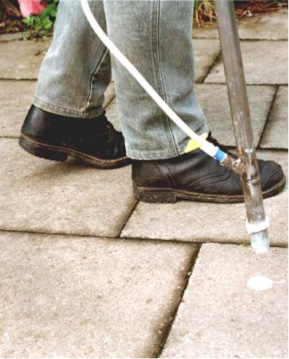
The paths taken by a person (Matthias S.) through the streets of Essen on 9th April 1994 were traced with dots using a container of grey paint attached to the hip and connected via a pipe to a walking stick (print stick) with a stamp pad at the end.
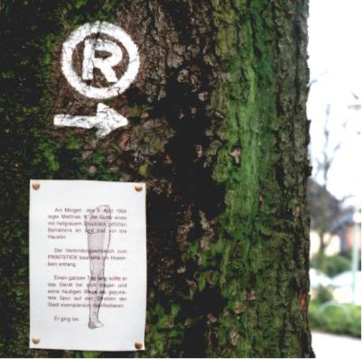
Some days later, notices explaining the origin of the dots were attached with drawing pins and tape to lamp posts, trees, etc., - all those places along his path that are used for private, unofficial information aimed at the public ("Cat disappeared!", etc.)
Taken as a whole, this is about very discreet interventions that were to generate a small amount of confusion in the first place but then grow into an intensification of the perception of public space as a sphere of a large, living, functional connection. On the one hand, this is brought about by a sensitisation for the surface phenomena of the streetscape, which is covered in the most different graphemes; trodden-in chewing gum, birds' excrement, etc., which all bear witness to the complicated system of life processes which surround us (and in which everyone is involved).
On the other, the dotted trace as paradigm allows passersby to position themselves in relationship to it according to their individual preferences. The stroll, the way to the telephone box, to the recycled glass container, the path to take the dog for a walk, the entrance to the shop, to work, etc.; all these paths trodden by countless people may overlap for a while with the dotted line, which simply represents the possible path of a definite person who also serves as an example. Perhaps they follow the trail for a while, leaving it suddenly to come back to it later at another point…
In this way, the project can contribute to an increased awareness of public space as more than simply an inexpressive sphere which one crosses from A to B. The paths travelled serve to release this experience.
Some of the explanatory notes were quickly taken and were replaced in the following weeks. As a whole, the project was a temporary occupation of public space. In about two months, the dots disappeared as a result of the weather and being worn away. This outcome corresponds to Hasucha's methods, as he has already demonstrated in numerous towns in similar projects (including in St. Petersburg and Graz), in which he avoids his public interventions becoming visual habits by remaining too long, and thereby losing their ability to create unease.
Office for syntactical Confusion
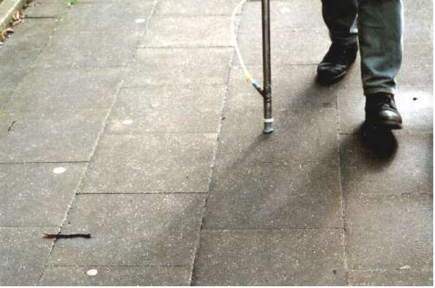
Cf. Project documentation Nr. 19 April 9th on the foot