

Johannes Imdahl
Christian Hasucha: 'Reacclimatisation Room'
Galerie bauchhund Salonlabor, Berlin
31.10.2014 – 06.12.2014
A room goes travelling - not for the first time in Christian Hasucha's series of 'Public Interventions' that he has been undertaking for many years. A few years ago the artist (born 1955 in Berlin) emptied the one-room flat of his neighbour, Günter, and recreated it at the same height and in the same orientation for two weeks on scaffolding in the inner city area of Müllheim an der Ruhr. He included the furniture and the window with the cushion that his neighbour liked to lean on, and allowed Günter to live there.
Now Hasucha has transferred himself and his studio-office from the Karl-Marx-Strasse into the Galerie bauchhund Salonlabor for five weeks. Bulky, for the authentically ordered recreation on a 1:1 scale was squeezed in with its wooden walls and turned to a 35° angle in its host space. What was visible through the gallery window was confirmed upon entry: here two rooms that share the door and the ceiling intersect and fight for validation. More hypothesis than fact, the reconstructed room, whose windows are just open apertures, with its implied sloping roof, almost complete original features and the artist working at the desk, arouses questions about the certainty of spatial identity - how detachable is a room from its location, what is actually happening here?
Furthermore, the reconstructed office functions as a reacclimatisation room.
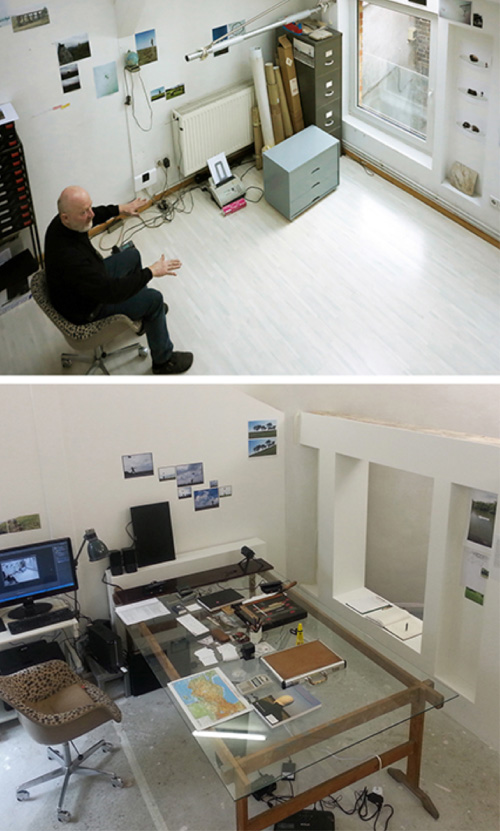
CHRISTIAN HASUCHA, Recclimatisation Office, 2014,
1:1 reconstruction of Hasucha's office, travel documentation.
Above: original office, partially cleared
Below: reconstruction in the bauchhund Salonlabor gallery space
Photos: copyright Christian Hasucha/VG Bild-Kunst, 2014
Christain Hasucha was travelling along the Black Sea coast in his workshop van for roughly six months wherever his route took him and worked in those places he found suitable for his ideas. During his journey he "rotated the horizon, redrew or doubled shadows, implanted and removed clues in the landscape, threw something in the wind, played Sergei Rachmaninoff on the car radio to frogs or showed a river which way it was flowing.'" The 'Reacclimatisation Room', not without irony situated south-easterly of the real studio-office, serves Hasucha as a place of semi-public stop-over, and the ordering and processing of his travel interventions.
'Der Tisch und sein Berg' (The Table and its Mountain), for example, can be seen in sketch form and as a photograph. The table with its black, metallic frame is placed on the coastal rocks near Abana (Turkey), behind it is the sea. A piece of rock juts like a mini mountain through a hole in the table cut out with a jig-saw. This table looks quite different to its glossy, physically more present counterpart in the recreated office. Pictorially transformed into a familiar yet lonely object, it triggers a special sensation that perception only gradually follows. Bathed in a soft light, the rocky surface in the lower half of the image and its dynamic contour running diagonally across the image contrasts with the soft surface of the sea and its straight horizon. The table, only slightly altered in its form, enters as an archetypal cultural object, as a cipher of human presence in this archaic scenery.
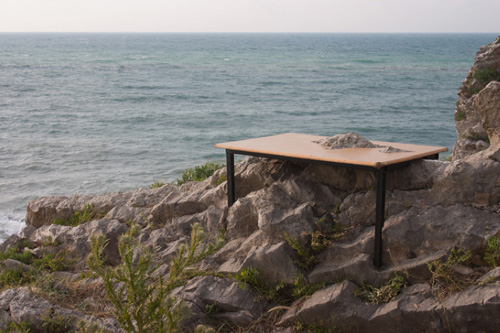
CHRISTIAN HASUCHA, Der Tisch und sein Berg, 2014,
Interconnection of table and coastal rock near Abana (Turkey).
Photo: copyright Christian Hasucha/VG Bild-Kunst, 2014
Like a hinge between mankind and nature, he poeticises and explains the landscape by sculpturally seizing upon a landmass protruding from the sea's surface, embedding it in the landscape and equally implying that it is a model in itself. The work, loosely pinned on the wall as paper prints, does not present itself as a glossy trophy of the expedition; it does not pay homage to a photograph that elevates itself above its object. Far from any suspicion of a digitally manipulated intervention, the image allows a considered, associative engagement with its origins without touching upon technical matters.
A moving image work is similarly refined. A portrait format LCD-monitor shows 'Der Schatten und sein Bruder' (The Shadow and its Brother), an image also devoid of human presence, in which a sunshade is centrally placed throwing a shadow to its left. A second shadow slowly fades in and out to the right, temporarily completing the compositional symmetry of the image; a very short loop with no movement of the sun and cleverly made, for there is no fading in and out of the waves in the sea in the background. A working photo near the sunshade shows that the shadow to the right is water sprinkled on the sand.
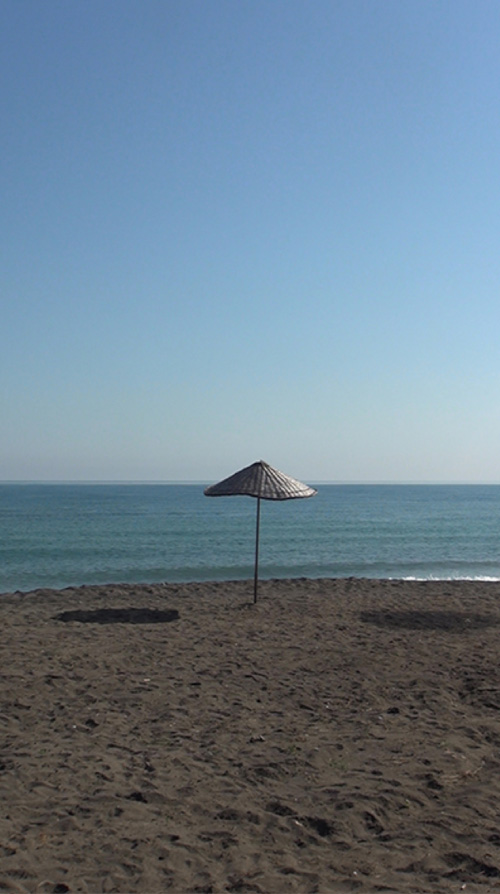
CHRISTIAN HASUCHA, Der Schatten und sein Bruder, 2014, Video loop,
Coast near Ordu (Turkey), sunshade, water sprayed on sand and documented with stop-motion.
Video: copyright Christian Hasucha/VG Bild-Kunst, 2014
A further video is of a more documentary nature and shows how Hasucha works with a small gravelled area surrounded by woods and fields. Using a cardboard stencil and white spray paint, he marks a parking bay with four right angles. The amusingly assembled video shows the working process and ends with Hasucha carefully parking, with bit of shunting to and fro, the converted transporter that serves as his workshop and mobile home within the right angles - like the satisfy-ing ending of a necessary process. Later, he leaves the marks as a questioning of a symbol outsi-de its usual context.
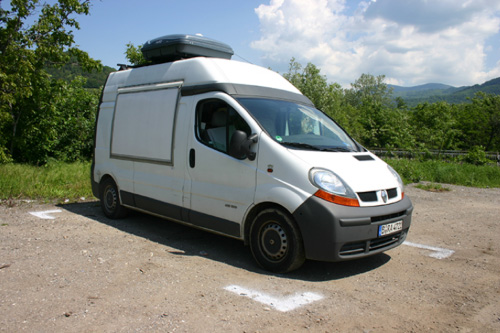
CHRISTIAN HASUCHA, Claim for a day, 2014,
Spry paint markings on gravelled area near Baile Heraculane, Rumania
Photo: copyright Christian Hasucha/VG Bild-Kunst, 2014
'Flusspfeil' (Directional Arrow) also stamps a symbol on the landscape. Near Veliko Tarnovo in Rumania, Hasucha built a five meter long wooden frame covered in white foil and placed it in the middle of the River Jantra following the direction of its flow. It was secured with nylon threads and stones to keep it in place. From certain standpoints, the object no longer appears to be laying on the surface but floating in front of the passing stream of water - an effect that, through the con-struction of the arrow that overturns its perspectival tapering and fits the single eye view of the ca-mera, is first shown to full advantage in the film.
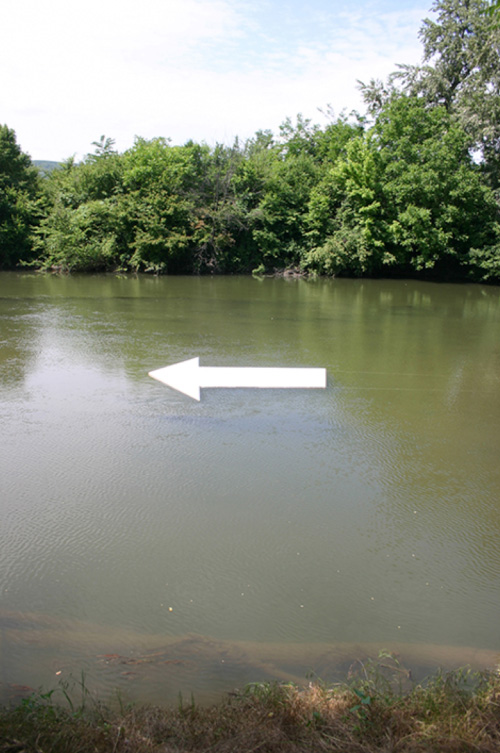
CHRISTIAN HASUCHA, Flusspfeil, 2014, photo and video documentation,
wooden construction covered in white, fixed in the River Jantra near Veliko Tarnovo (Bulgaria) with fishing line.
Photo/video: copyright Christian Hasucha/VG Bild-Kunst, 2014
Over and again, Christian Hasucha configures the familiar with the familiar giving rise to a strange, confusing third that attracts attention, breaks open patterns of perception and excites aesthetic reflection. The apparently self-evident importance of organising and indicating instruments is subtly parodied and questioned. During his journey through Turkey, Bulgaria, Rumania and Georgia, the artist, according to his own statement, came across places that were sympathetically open to im-provisation and self-regulation, whereas in his own society a progressive standardisation in the formation of everyday life could be observed.
Along the border between everyday life and art - the area that Hasucha prefers to work in - numerous people whose language he did not speak, happily came to help, as some works and materials document. The table near Abana was given by a Turkish mayor, Bulgarian men in swimming trunks helped with the arrow in the river.
Christian Hasucha's 'Reacclimatisation Room' allows an unconventional look into his work in progress, he does not hide the complex processes which lay behind the manifestation of his works. The artwork, it seems, loses something when it is reduced to the result: a photo, the installation or a video. The sketches, stories, actions, movements and interactions as artistic gestures, as social sculpture, vitalise the work, whereby the question of what is actually happening in this reconstructed room is answered.
Cf. Project documentation Nr. 67 Reacclimatisation Room