| 1) |
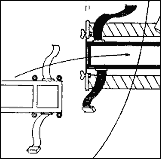
First the seat discs, (Abb: SILA, German: Sitzlamellen) are lifted up from the white support components and, as far as the hinges allow, unrolled as tightly as possible.
|
| 2) |
Then the four screws are unscrewed out of the stabilization cross beam (Abb: STABIK, German: Stabilisierungskreuz). Both of the white support components are bolted to the transport frame (Abb: TRAPORA, German: Transportrahmen), paying attention that the fastening belts remain freely moving.
|
| 3) |
The unfurled SILA are now laid on the TRAPORA between both fastening belts and the belt is closed as tightly as possible.
|
| 4) |
The STABIK is shoved under both belts so that they receive additional tension.
|
| 5) |
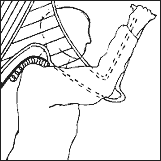
The TRASBA can now be lifted remarkably easily. The carrier person arranges himself with his head positioned between the white support components. The TRASBA rests stable on the shoulders and can be adjusted to the most comfortable carrying position. Transport stretches of several kilometers long are now possible.
|
| 6) |
The bundled up TRASBA is dropped off, in a way that the SILA is set up in an exact vertical position. The head of the carrier emerges from the white support components. The SILA-bundle must remain there unconditionally in a vertical position.
|
| 7) |
Then the TRASBA is laid on the ground so that the unfurled SILA is on the upper half of the TRAPORA.
|
| 8) |
The fastening belts are now to be loosened. The SILA as well as the STABIK are laid aside. Next the TRAPORA is separated from the white support components and is bolted to the STABIK is bolted to the support components. The SILA is then, beginning with the uppermost disc, hung on the iron nib of the support components. The third block is arranged for the back and the fourth block is actually for the seat surface of the SILA.
|